Wishonda · RuleFinder IQExplore RuleFinder IQ ↗

A visual reasoning guide

See the rule.

A visual matrix asks you to look for a relationship among shapes. These three checks help you explain what you see, then test it on a complete worked example.

Try the free 22-puzzle challenge ↗

Try six guided drills ↓

The illustration and example are original, unscored teaching material, not questions from the product. You do not need a paid report to start.

By Wishonda · Published 4 October 2026 · Practice added 6 October 2026

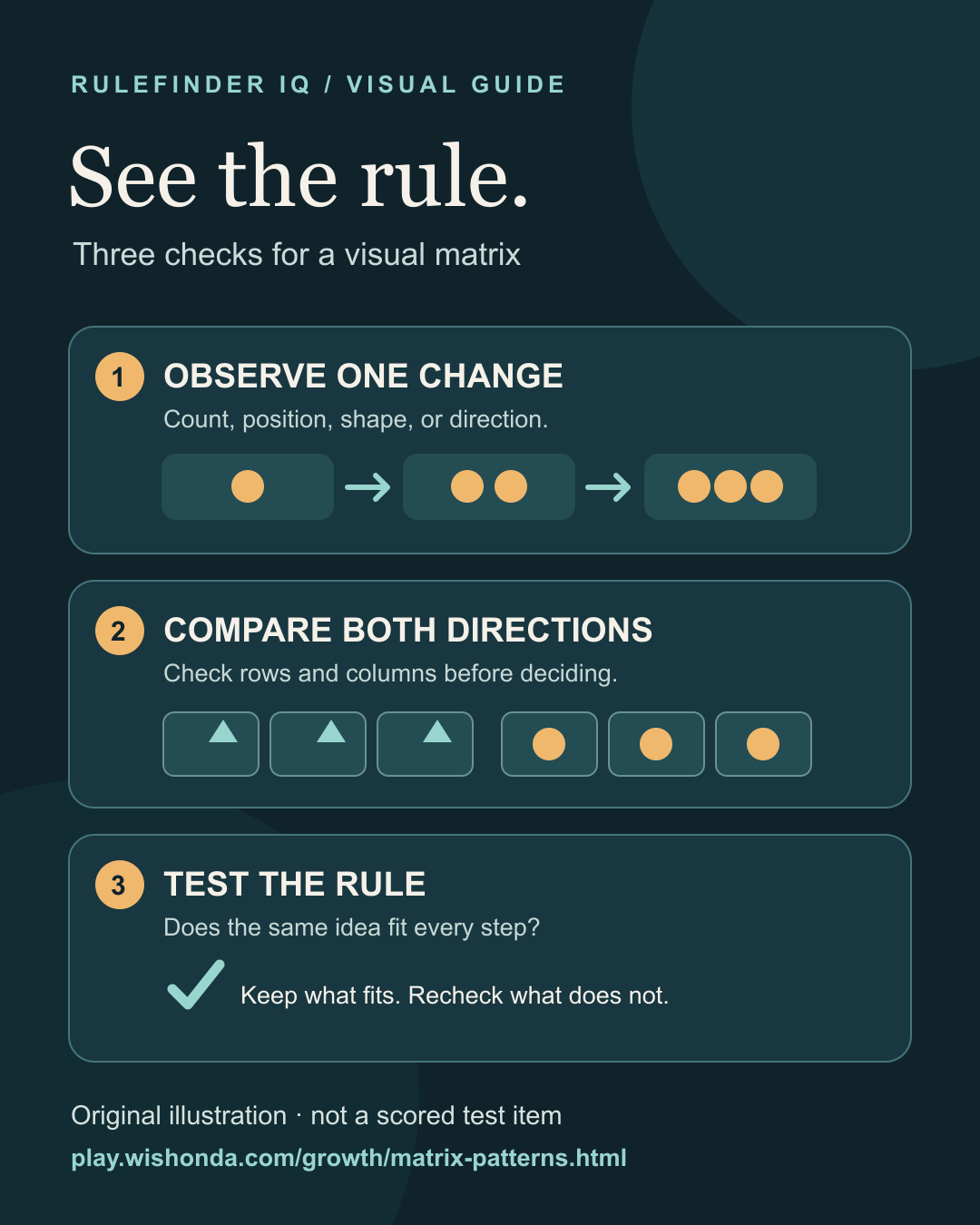
Original visual guide: observe one change, compare rows and columns, then test the rule

A simple way to begin

01

Observe one change at a time.

Look at one row. Does the number of objects change? Does one object move, rotate, switch shape, or change colour? Describe what you can actually see before deciding what should come next.

Try saying: “From the first cell to the second, I see one more dot.”

02

Compare rows and columns.

A rule that seems plausible across one row may fail elsewhere. Check whether the same kind of change appears in another row, then look down a column. If the pattern differs, revise the idea rather than forcing it.

Ask yourself: “Does this explanation work in more than one direction?”

03

Test the rule against every visible step.

Before choosing an answer, apply your proposed rule to the cells you can already see. Check what it predicts and where it breaks. More than one feature can change, so keep your explanation specific and open to correction.

Ask yourself: “Which visible cell would prove my idea wrong?”

Pattern Lab · six original drills

Learn the check.
Then make the choice.

Choose an answer, check the rule, and see why the other options do not fit. Try it at your own pace. Hints are optional.

Free · No signup · No countdown. Original teaching material, separate from the 22-puzzle assessment. These examples are not official employer tests or clinical measures.

Your answers and practice summary stay in this page. We count anonymous steps by UTC hour and entry-source label: exercise viewed, started, first answer checked, completed, IQ product link clicked and planned workbook preview clicked. No answer, score, name or session identifier is sent. Reloading may count again.
Read across a row. Check the same idea against another row or column.

Show a hint

Try it yourself · unscored example

Which shapes replace the question mark?

This grid uses two simple rules at once. Before opening the answer, describe what changes as you move across a row. Then describe what changes as you move down a column. Do both observations predict the same missing cell?

Read each cell across and down. The marks are symbols, not a product score.

Three possible answers: A · two squares   B · three triangles   C · three squares.

Reveal the answer and why it fits

C · three squares. Across every row, the number rises from one to two to three. Down every column, the shape changes from circle to triangle to square while the count stays fixed. The missing cell must satisfy both rules: the third column needs three marks, and the third row needs squares.

A fails the across rule because it has only two marks. B fails the down rule because it repeats triangles in the square row. Checking both directions helps reject a choice that looks plausible in only one direction.

Real matrices can use rotation, position, colour, or several interacting features. A proposed rule is useful only if it also explains the visible cells; if it does not, try a different rule.

A second worked example · original practice

Track position separately from count.

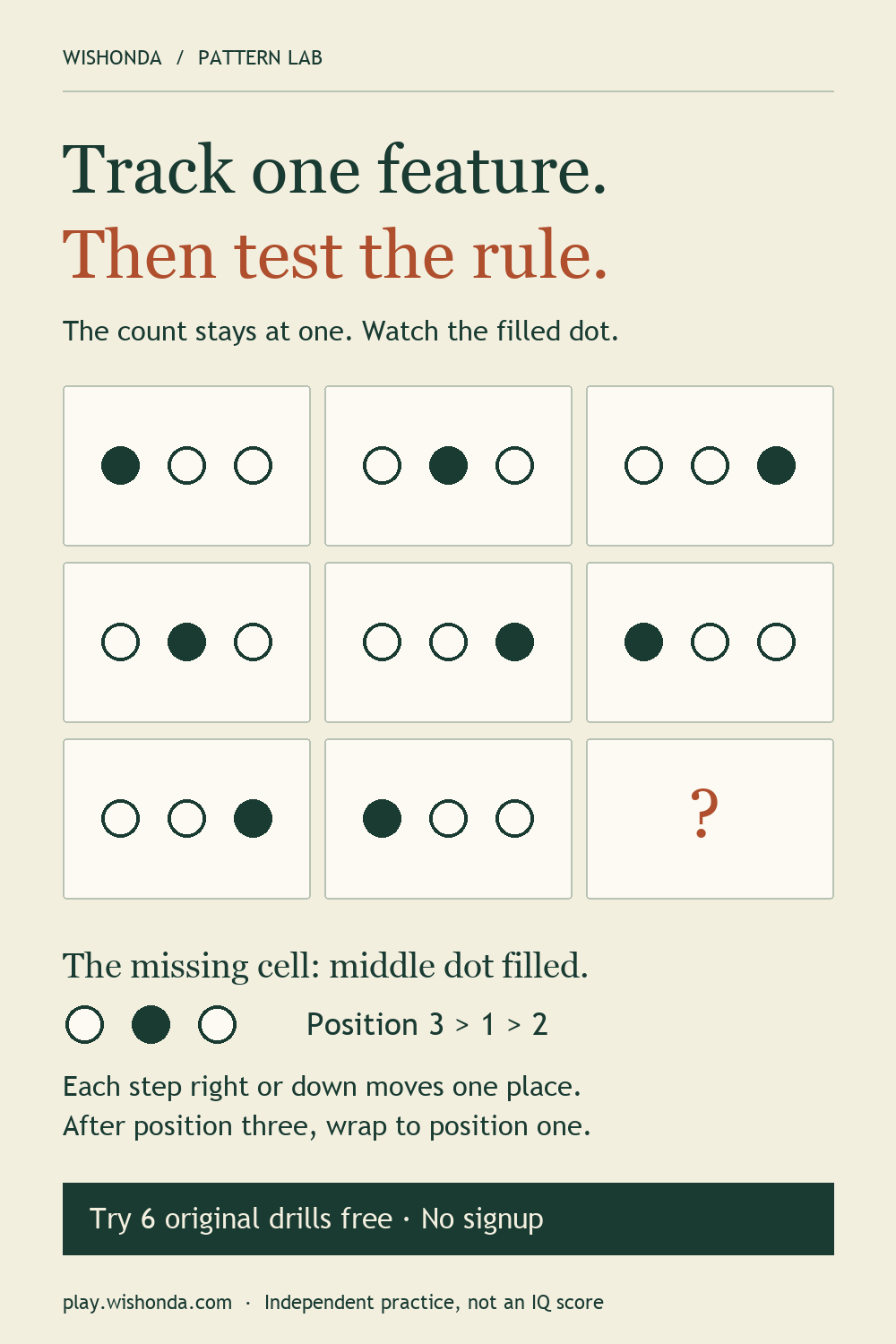
This is the moving-marker rule from the fourth free drill. Each cell keeps one filled dot; the position moves one place right with every step across or down, wrapping from the third position to the first.

See the moving-marker grid and explanation
Original moving-marker example. Filled-dot positions are 1,2,3 in row one; 2,3,1 in row two; 3,1,missing in row three. The missing cell has the middle dot filled. Each step right or down advances one place, wrapping after three.
Check two directions. The last row is position 3, position 1, then position 2. No score or ranking is inferred.

Practise all six rules free ↑

A useful habit

Explain, then choose.

Notice. Name a visible change without guessing what it means about you.

Check. Compare it with the other cells and look for exceptions.

Decide. Pick the option that best fits the rule you can explain, then move on.

Explore the full experience

22 puzzles. Your answers in context.

RuleFinder IQ starts directly with the first formal matrix puzzle. You can begin for free and review feedback grounded in your answers. The optional deeper report is USD 2.99. Its research reference is context for the task, not a global population ranking or a clinical IQ diagnosis.

This guide does not reveal a scored test item, guarantee a result, or measure your intelligence.

Start the free challenge ↗