Wishonda · Practice guidesSix free drills ↗

South Africa · Assessment preparation

Start with the test type.

An online assessment invitation is a task to understand before it is a test to practise. Match your preparation to what the employer actually asks.

By Wishonda · 6 October 2026 · AI-assisted editorial content, checked against the official sources linked below. Wishonda makes Pattern Lab; this is independent guidance, with no employer or assessment-provider affiliation.

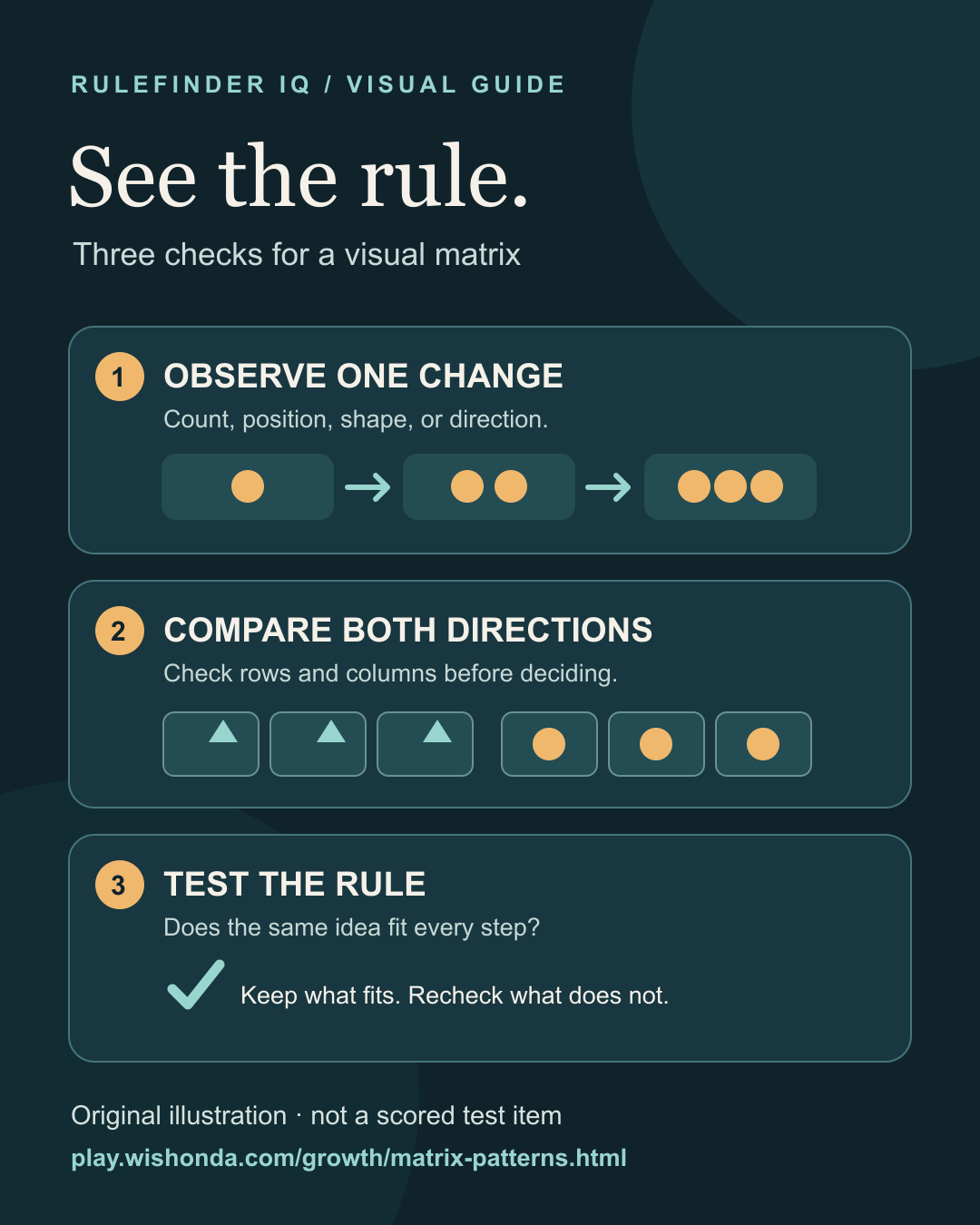
An original visual rule practice illustration, not an employer's assessment question.

Before you practise

01

Read the invitation closely.

Write down the provider, assessment name, deadline, permitted equipment and any preparation links. A numerical test, a coding task, a case study and a visual reasoning exercise call for different preparation. If the format is unclear, ask the recruitment contact before buying a practice pack.

For one concrete South African example, Standard Bank’s student and graduate hiring guide describes role-specific technical exercises, case studies and/or psychometric assessments. That supports checking the role and invitation; it does not mean every applicant gets a visual matrix test.

02

Use the provider’s examples first.

Official examples can help you understand the controls and question format. SHL’s candidate support lists free practice resources and short examples with explanations, while noting that not every assessment or language is covered. If your invitation names another provider, use that provider’s instructions.

Check: Can I explain the instructions, submit an answer, and recognise the time limit? Practising an unrelated question type is not a substitute for these checks.

03

Explain the rule before choosing.

If visual or abstract rule questions are relevant to your invitation, practise checking an idea against more than one complete row. The original example below shows why an attractive first guess can fail.

An original teaching example

Which number completes the last row?

Describe a rule that fits both complete rows, then apply it to the last row. Choices: 2, 3, 4 or 5.

12323531?
Created for this guide. It is not a real employer’s test item.
Show the answer and the rejected guess

4 is the intended answer. The first two values add to the third: 1 + 2 = 3, then 2 + 3 = 5. The same rule gives 3 + 1 = 4.

Why reject “add one”? It fits the first row’s consecutive values, but fails on the second row: the last value is 5, not 4. One matching row is insufficient evidence.

Finite puzzles may admit other descriptions. This example teaches the intended row-addition rule, not a universal method for every assessment.

Three short sessions

Prepare, explain, review.

Session 1 — Format. Read the invitation and try the provider’s relevant official examples. List anything unclear.

Session 2 — Reasoning. For each practice item, record the intended rule and one tempting explanation that fails. Check the worked answer.

Session 3 — Review. Revisit mistakes without looking at the solution first. Follow the actual provider’s instructions for timed practice, equipment and breaks.

This is a suggested study structure, not a validated programme or a promise of score improvement. Use independent practice before the assessment; follow the employer’s rules during it.

Optional independent practice

Try six original drills.

Pattern Lab offers six free visual-rule exercises with hints, worked explanations and common traps. There is no account or payment requirement. It covers a small set of rules; it does not replace provider-specific preparation or cover every hiring assessment.

Try the six free drills ↗

A separate 24-exercise workbook is in preparation, with a proposed one-time US$7.99 price. It is not currently for sale. Independent educational content for adults 18+; no official affiliation, clinical IQ score, job guarantee or promised outcome.