Start on your own.
Answer 12 everyday questions privately. See an answer-based personal preview, then choose whether the full report is useful to you.
Start the free reflectionFree preview. Optional full personal report US$1.99. Inviting someone is your choice.
 A quiet way to compare
How it works
Your view comes first.
- Answer the 12 questions about everyday relationship moments.
- Read your personal preview. A deeper individual report is offered for USD 1.99.
- Invite someone only if you want a two-person comparison. That report is offered for USD 3.99.
Optional full personal report · US$1.99
Words to use.
Space to reflect.
Your full report includes two conversation scripts based on your actual answers, with the choices behind each suggestion.
A printable seven-day observation sheet gives you space to record a situation, what support you wanted, and a small next step to agree on. Keep these notes on paper; UsMirror does not collect what you write on the sheet.
Inspect a complete sample report using synthetic answers ↗
Read your free personal preview before deciding. The personal report works on your own; a second person is optional.
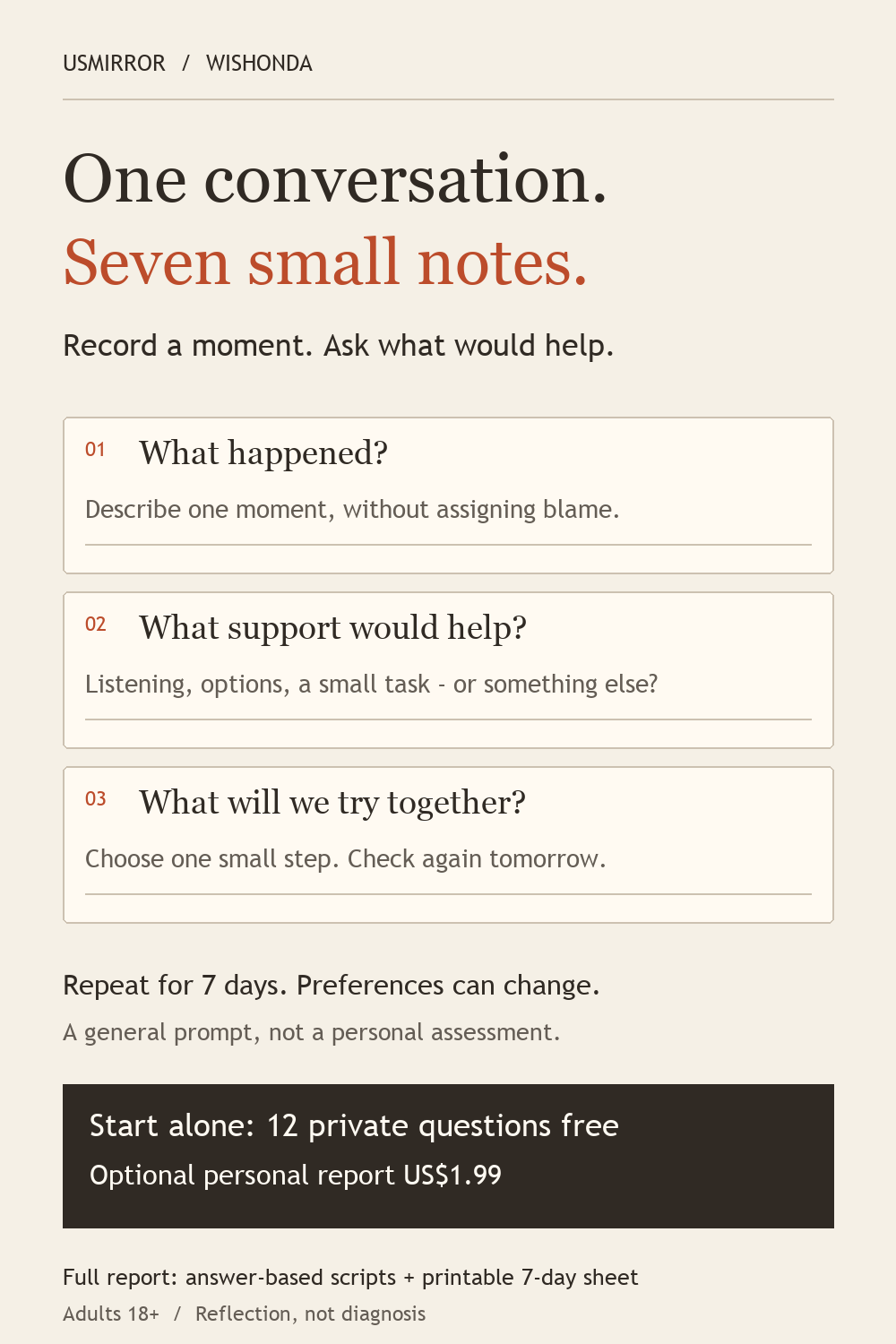
See a general check-in prompt
This blank prompt illustrates the use. Your personal report uses your own answers; this image is not someone’s result or a clinical assessment.
Your choice
Reflection without pressure.
Inviting a second person is optional. Your answers are kept private from them; the shared view focuses on the comparison.
This is a reflection tool, not a diagnosis. Any birthday-based cultural lens is separate from the answer-based interpretation.
Begin with your own view.
Free to start. Decide what to unlock after seeing your preview.
Want a conversation starter first? Read three questions about feeling supported.
After a disagreement, try three optional check-in questions.
See why knowing someone and agreeing with them are different: read two everyday examples.
Try UsMirror